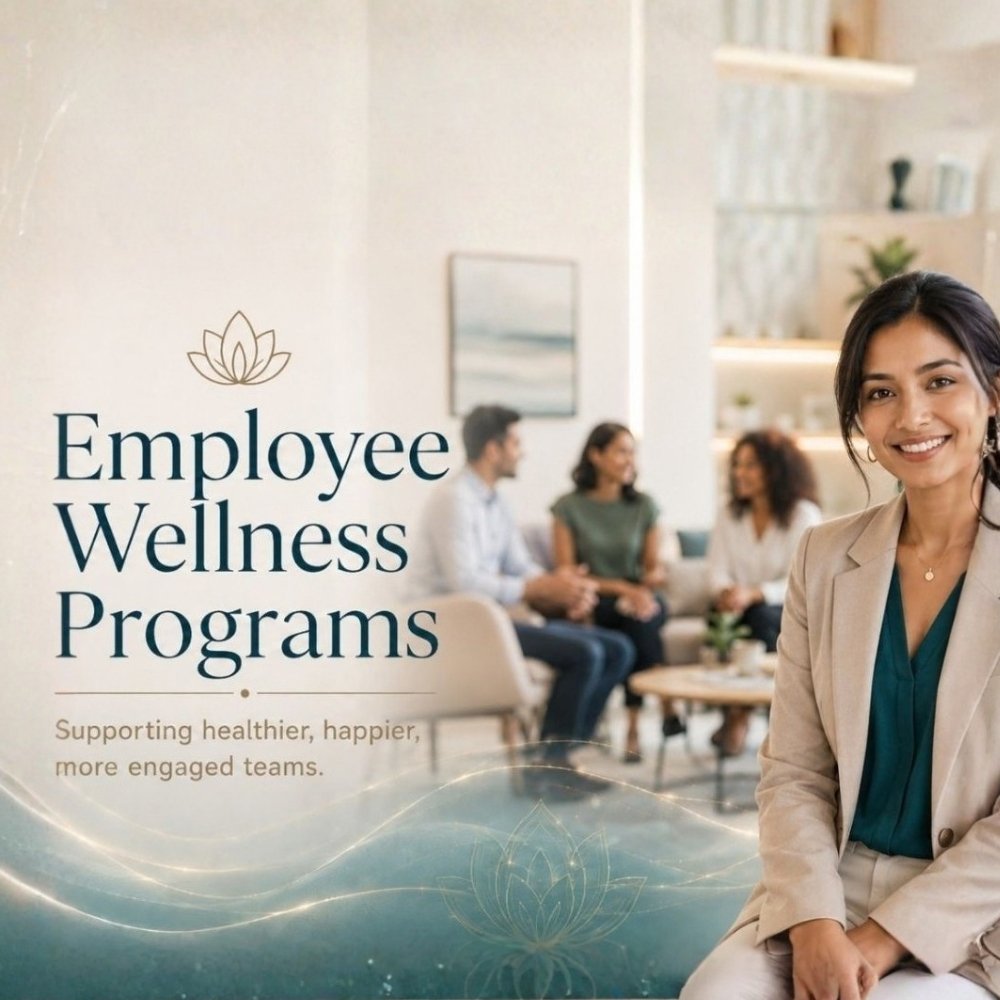

You’ve been given access to an employee wellness program.
Maybe it’s an app. Maybe there’s a meditation room no one uses. Maybe it’s a reminder in the company newsletter to “take care of yourself this weekend.”
And yet — Sunday evening still feels heavy. Monday morning still takes something out of you. Wednesday afternoon, somewhere around 3 pm, you feel a kind of tired that sleep doesn’t quite fix.
Here’s what that feeling is telling you: the program your organisation offered was designed around what is easy to provide — not around what you actually need.
This article is for employees. It’s also for the people in HR who genuinely want to get this right. Because the gap between what most employee wellness programs offer and what genuinely supports human beings at work is wide. And it is closeable.
Why Most Employee Wellness Programs Feel Hollow
Ask most employees what their workplace wellness program has actually done for them, and the honest answer — beneath the diplomatic one — is: not much.
This is not because the programs are poorly intentioned. It’s because they are often designed around the assumption that employee wellbeing is primarily a mental or behavioural challenge — a matter of mindset, habits, and information.
So we get step-count challenges. Webinars on sleep hygiene. Breathing exercise reminders. All of which have value in isolation, but none of which address the underlying physiological reality of what sustained workplace stress actually does to a human body.
The uncomfortable truth is this: when you are chronically stressed at work, you are not primarily experiencing a thinking problem. You are experiencing a nervous-system problem.
Cortisol accumulates. Breathing becomes shallow. The gut — which produces the majority of the body’s serotonin — becomes dysregulated. Sleep becomes lighter. Concentration frays. And a sense of quiet depletion settles in that no amount of motivational content seems to shift.
Until an employee wellness program addresses the body — not just the mind — it is working upstream of the problem.
Table of Contents
What Employees Are Actually Asking For (Even When They Can't Articulate It)
When employees disengage from wellness programs, it is usually framed as a participation problem. But it is more often a relevance problem.
What employees are looking for — whether they can name it or not — is this:
To feel genuinely seen, not just managed. A wellness initiative that arrives as a policy update or an app notification communicates that the organisation has checked a box. What builds real trust is an experience that acknowledges the full human being at work — not just the professional persona, but the stress, the fatigue, the emotional undercurrent that most people carry quietly from Monday to Friday.
To feel different in their body after, not just informed. The most effective wellness experiences are not ones that give employees more information. They are ones that help employees feel a tangible shift — in their breath, in their posture, in their mental clarity — within the session itself. That physiological experience of regulation is far more motivating than any slide deck on stress management.
To understand themselves better, not just perform better. Employees don’t want to optimise. They want to understand why they feel the way they feel — and what, if anything, they can do about it. Education that connects lifestyle, nutrition, gut health, and nervous-system function to daily experience gives people a framework that belongs to them. It doesn’t expire when the program ends.
To belong to something that takes wellbeing seriously. When an organisation invests in a genuine, thoughtful wellness experience — one with depth and intention — it signals something meaningful about values. Employees notice. And that signal carries into how they relate to their work, their colleagues, and the organisation itself.
The Science That Most Wellness Programs Aren't Using Yet
There is a growing body of functional health research that is beginning to reshape how thoughtful practitioners approach employee wellbeing. Three insights in particular are worth knowing.
The gut-brain connection is not metaphorical. Approximately 90% of the body’s serotonin is produced in the gut. This means that an employee’s emotional regulation, mood stability, and cognitive clarity are directly influenced by gut health — which is, in turn, affected by stress, sleep, and diet. A wellness program that ignores nutrition and the gut-brain axis is leaving one of the most significant levers untouched.
The nervous system needs to be regulated before it can be educated. Information lands very differently on a nervous system that is in a state of low-grade threat activation versus one that feels safe and regulated. This is why some of the most effective wellness interventions begin not with content, but with the body — breathwork, gentle movement, grounding — before anything cognitive is introduced.
Stress lives in the body, not just the mind. Chronic workplace stress creates physical tension patterns, altered breathing rhythms, and postural changes that persist even when the stressor is technically removed. Practices that work with the body — movement, sound, energy awareness, creative expression — can help discharge accumulated stress in ways that purely cognitive approaches cannot reach.
None of this requires believing anything unusual. It is increasingly well-supported functional health science — and it points toward a very different kind of employee wellness program than most organisations are currently running.
What a Genuinely Effective Employee Wellness Experience Looks Like
Imagine arriving at a wellness session at work and being welcomed with a warm drink and a Wellness Journey Kit. Your blood pressure is gently checked. There’s ambient sound and fragrance in the room. Before anything is asked of you intellectually, you are helped to arrive — to leave the morning meeting behind and actually land in the space.
What follows takes you through a carefully sequenced journey.
First, the body: guided stretching, breathwork, and hand mudras that stimulate energy pathways and begin to shift the nervous system out of activation. Not performance. Not productivity. Just regulation.
Then, the emotions: a guided Mandala Art session where you choose three colours — one for how you feel right now, one for how you’d like to feel, and one for the bridge between them. No artistic skill required. No right or wrong. Just a quiet, guided process of making your internal state visible without having to speak it.
Then, the mind: a Brain Break — something playful, a moment of laughter and release — followed by a period of self-reflection. What am I carrying? What am I ready to let go of?
Then, the deeper layer: a Chakra Meditation with mantra and sound — grounding, calming, and genuinely restorative in a way that is difficult to describe before you’ve experienced it. Followed by an introduction to Reiki energy awareness, and a talk on the gut-brain connection that explains, in plain language, why so much of how you feel every day begins in your gut.
By the end, you have a completed Mandala — a visual map of your own emotional landscape that you take with you. A small, personal artefact of a process that was entirely your own.
This is not a corporate tick-box. This is an experience that participants describe as one of the most genuinely restorative things their organisation has ever offered them.
The QORI Approach to Employee Wellness
This is the framework behind the QORI Wellness Workshop — developed by HealThyRam for the HealThyRam Niramaya Bharat Community, and designed specifically for the workplace.
QORI stands for Quantum Organisational Resilience Index. But the name matters less than the design principle behind it: that employee wellness can only be meaningful if it works at the level of the body, the emotions, the mind, and the energy — and if it generates something that can be measured, not just felt.
Each QORI workshop uses the WHO-5 Well-Being Index — a validated psychometric tool — to capture a snapshot of each participant’s wellbeing before and after the session. This data, anonymised and aggregated, feeds into the organisation’s QORI Resilience Score — a proprietary measure that tracks how collective employee wellbeing shifts over time.
The program is offered as three workshops per year, giving employees a meaningful rhythm of restoration rather than a single isolated event. Each session includes a Wellness Mela afterwards — a community space with free consultations from qualified Functional Medicine experts, wellness products, and connection.
For HR teams, this is an employee wellness program that employees will actually look forward to. For leadership, it is a program that generates real, reportable data. For employees — it is simply one of the most valuable things a workplace has ever offered them.
Five Questions to Ask About Your Current Employee Wellness Program
Before your next budget review or program renewal, it may be worth sitting with these:
- Does your current program help employees feel physically different — or just more informed?
- Is there a meaningful experience at the centre of it, or a series of reminders and resources?
- Does it address the body — movement, breath, gut health — or only the mind?
- Does it give employees something that belongs to them after it ends?
- Does it generate any data that tells leadership how their people are actually doing?
If the answers are mostly “no” — you are not alone. Most organisations are in exactly this position. The good news is that genuinely effective employee wellness programs exist and are accessible.
Ready to Experience a Different Kind of Workplace Wellness?
The QORI Wellness Workshop is available for organisations across India, with the flexibility to customise each session to your team’s context, size, and goals.
If you’re an HR professional wondering whether this could work for your organisation — or an employee who has forwarded this article to someone who needs to see it — the next step is simply a conversation.
Visit this QORI Wellness Workshop page to learn more, or write to us at qo**@********am.com to enquire about booking a QORI Wellness Workshop for your team.
There is no obligation. Just a conversation about what genuine employee wellbeing could look like in your organisation.
Disclaimer: This article is intended for general educational and informational purposes only. It does not constitute medical advice, diagnosis, or treatment. The wellness approaches described — including breathwork, Mandala Art, Chakra Meditation, and Reiki — are complementary practices and are not substitutes for professional medical or psychological care. The QORI Wellness Workshop is a workplace wellness experience and is not a clinical intervention. If you are experiencing significant physical or mental health concerns, please consult a qualified healthcare professional.